
Hellboy
🔥 Mike Mignola and what makes a good auteur artist

When I went to comics school, we mostly prayed at the altar of the auteur — a single voice, a solitary genius, a creative force. We chanted along names like Chris Ware, Art Spiegelman, and Alison Bechdel.1
We believed that indie comics by a single artist were artistically superior to superhero comics, which we viewed, rightly or wrongly, as a product of extraction and commercialism, with any subversive edges sanded off. And yet… I grew up with superheroes. As a boy I often ran around wearing a cape that my mom sewed, and I would sit in the aisles of Borders for hours reading Green Lantern.
Eventually I reconciled my appreciation for comics auteurship with my love for mainstream, beat ‘em up comics in the work of single creator — Mike Mignola. He’s one of the most iconic and prolific commercial artists of this era, and he embodies my theory about what makes the best kind of auteur: depth, evolution, and collaboration.
Depth
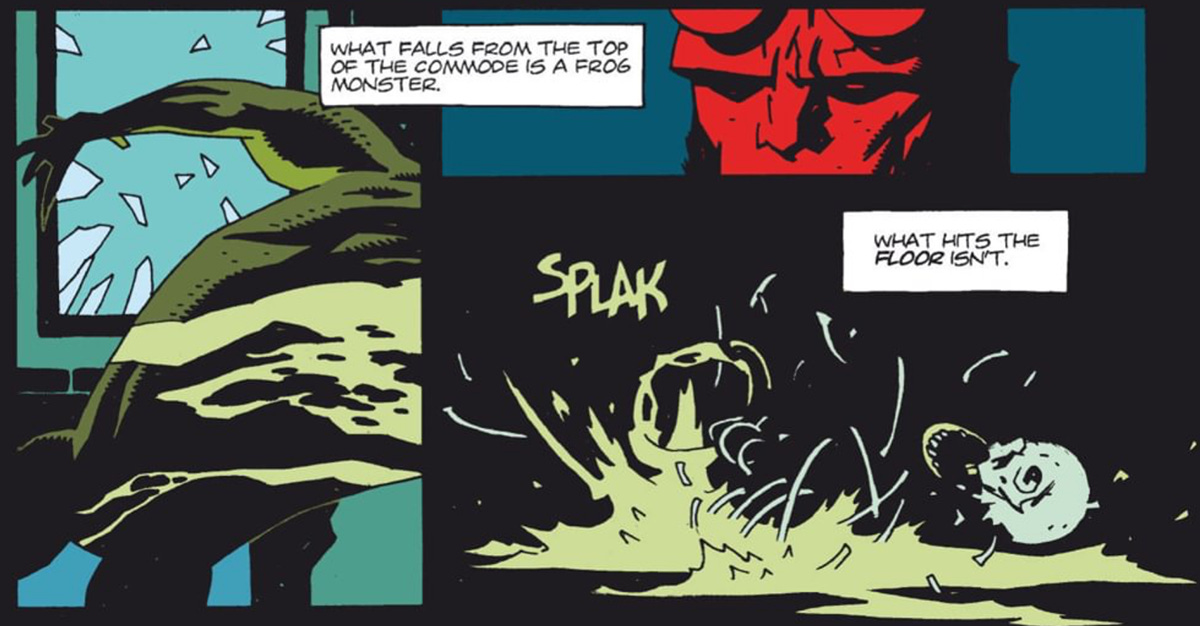
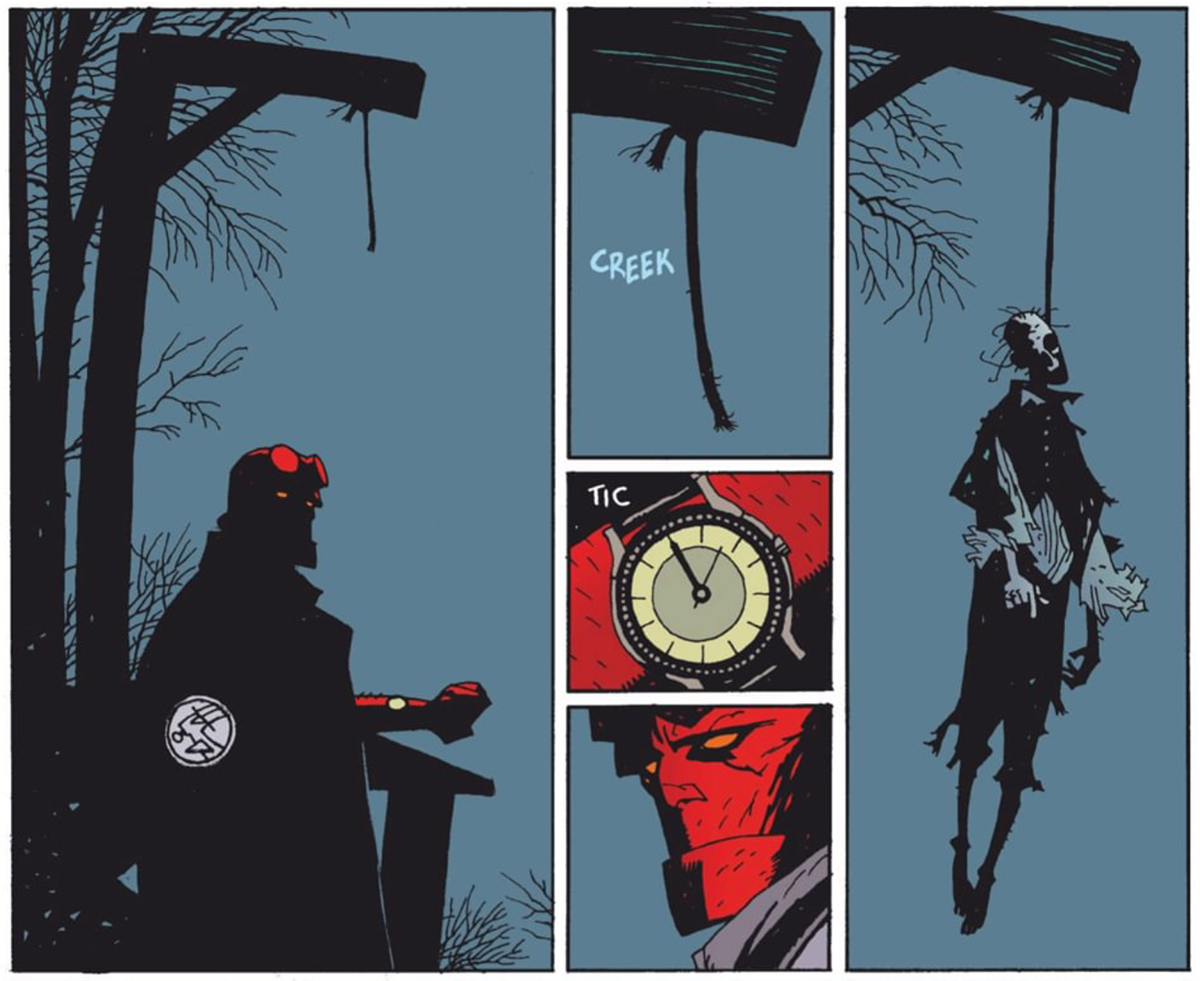
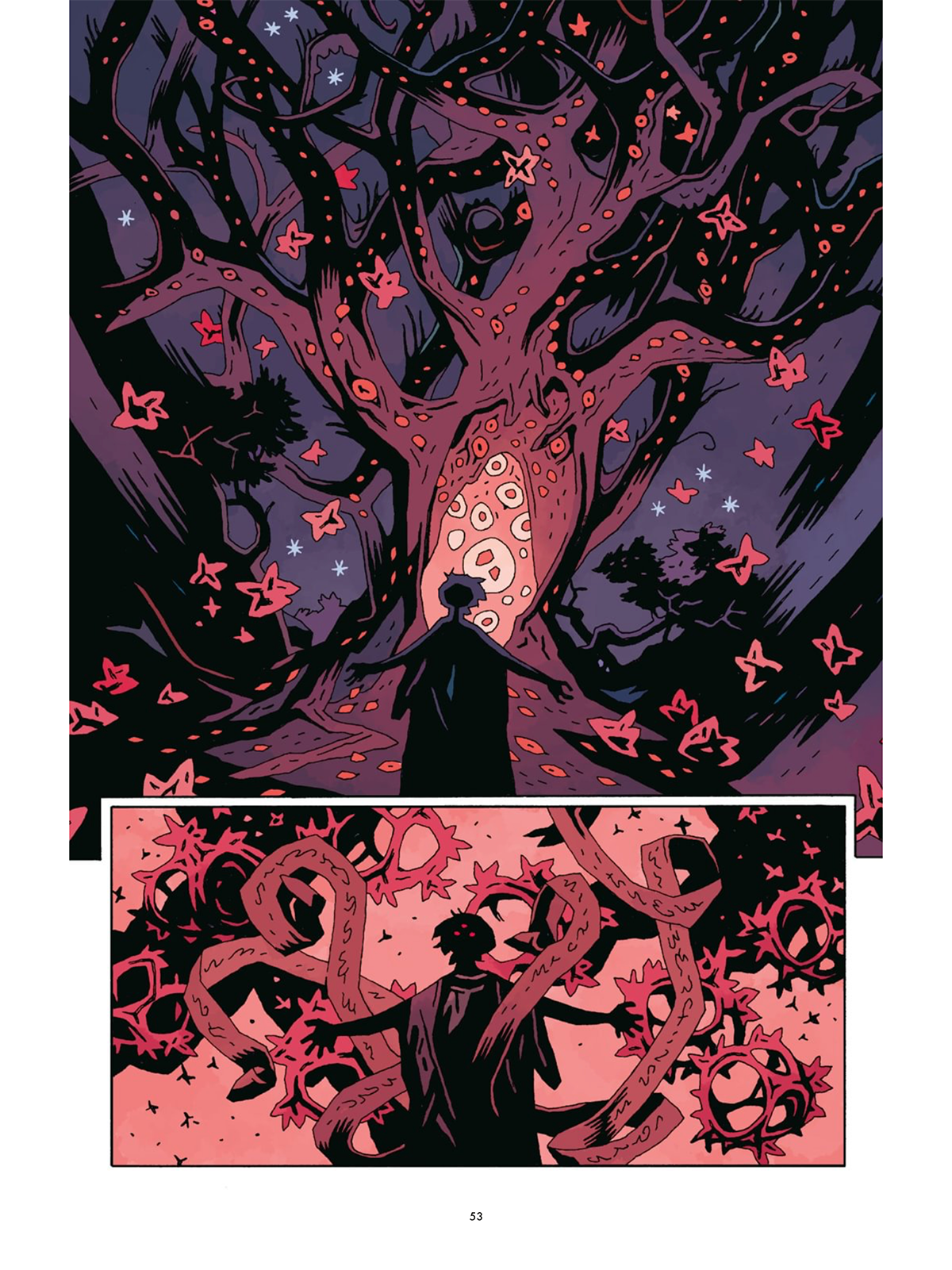
It’s not unusual for a singular artist to have a unique and recognizable style. Just like with Wes Anderson’s recognizable images, the first thing people notice about Mignola’s work is the art. Loaded with hard shadows, his pages typically have a lot of black. His fixed line makes a tidy scaffolding for all the dense darkness. His forms are rarely perfectly straight up and down: organic shapes meander, buildings are a big pile of stone. To me his drawing looks classic, with inspiration from mid-century pre-code2 comics, and he typically employs more vintage compositions than other contemporary artists.
In interviews, Mignola will say he avoids what he’s not good at drawing, like women and cars, but it’s just as true that he plays to his strengths, showcasing monsters and creepy environments like castles and graveyards. In all the black, the bright red of Hellboy pops.
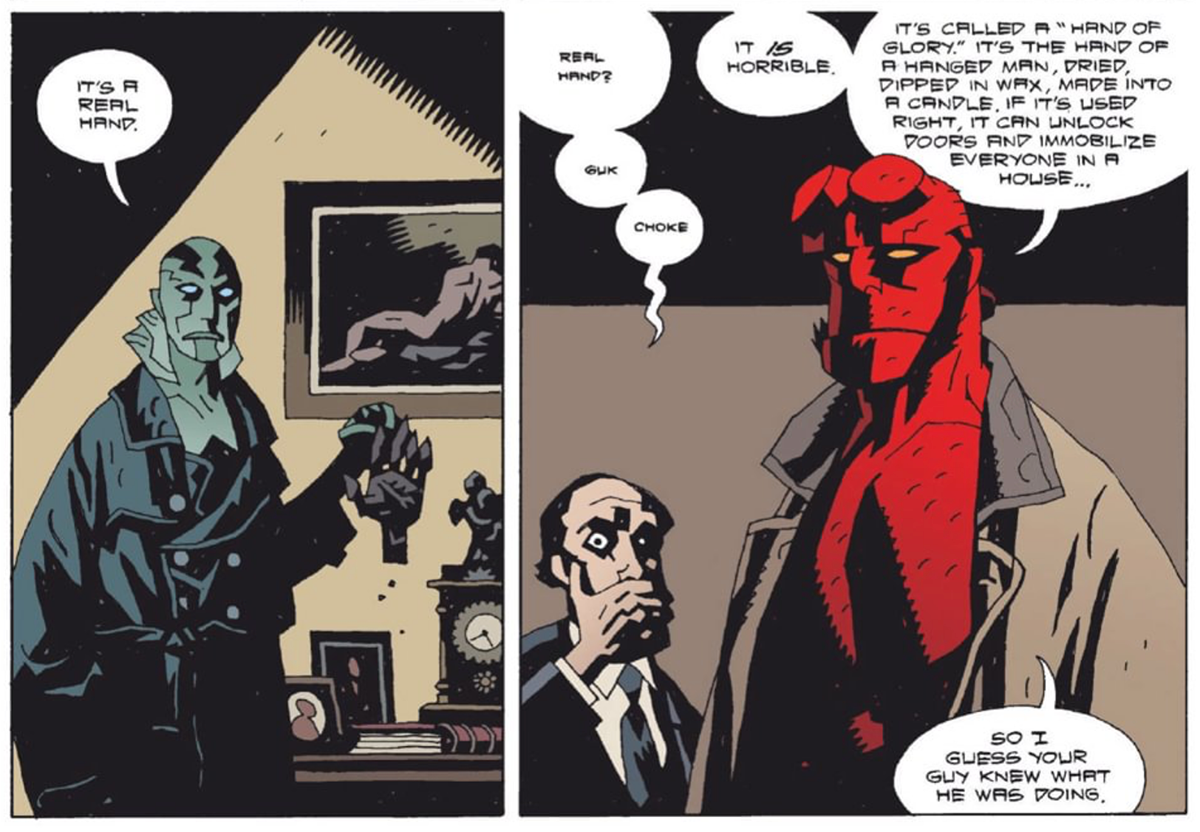
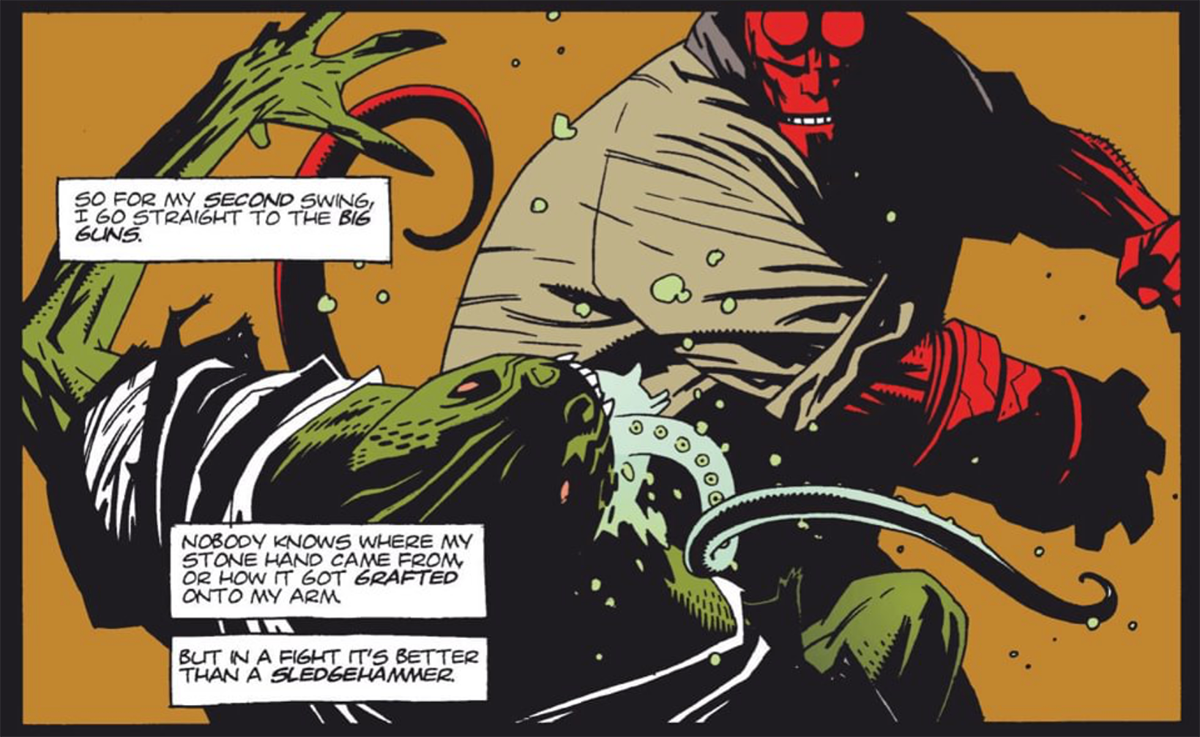
The story is simple enough: a boy demon is summoned from Hell, but is raised by the good guys to fight monsters. When we meet him in the very first series, Hellboy is 50. Unlike the Thing, Hellboy doesn’t struggle to live a normal life. He’s not hiding. He’s accepted by all, and everyone’s an old friend. Fighting monsters is mostly a workaday job, with coworkers like Roger, a homunculus who was laying dormant in a Romanian castle for 500 years. But internally, Hellboy’s afraid of what he might be — the end of the world.
Mignola grew up obsessed with ghost stories, and this stuff is varsity-level occult. These are deeply mythological tales, drawing from traditions all over the world. The ornate complexity washes over you, broken up by fight scenes with big monsters. Truly, pick up near any collection and you’ll see storytelling and art firing on all cylinders.
Evolution
It all started modestly, with a single sketch. It’s quite an origin story, and from the first page, the elements are seemingly fully-formed. Yet, as told in the very good (and free on YouTube!) documentary, “Mike Mignola: Drawing Monsters”, his road to his life’s work was winding and difficult. He worked in superhero comics for 10 years, very much not thriving or destined for greatness.
Eventually, drawing Batman stories set in a cemetery, and Victorian Gotham, Mignola pushed towards the sort of dark, gothic work he would perfect in Hellboy. When he did strike out on his own, he had to push himself to write for the first time. He battled it out, discovering his voice, which could be weird, grim, and sometimes funny.
He was in the right place (his publisher, Dark Horse Comics) at the right time (a speculative boom3 in comics collecting and the peak of the direct market4), with an incredible title. Still, movies really help in growing an audience. The “Mignola-verse” grew over decades, and seemingly every little piece of his fictional world became fodder for a new title and series. There’s deep consistency throughout the 30+ years of comics that followed. But that was only possible because he learned how to play well with others.
Collaboration
It may seem counter intuitive: isn’t the whole point of the auteur that they work alone? In my opinion, the best ones generously extend their vision and thrive through partnership with other talented artists.
Think of a director like Ryan Coogler. Even though “Sinners” is a deeply personal story and a reflection of Coogler’s unique vision, it’s only possible because of the incredible crew he’s surrounded himself with movie after movie. Comics, admittedly, is closer to fiction writing, in that all of the production can be done by one person. There are trade offs in writing and drawing one’s own story, or shaping it with a creative partner.
Mignola, who came up in the Marvel Method but then developed Hellboy as a creator-owned book at Dark Horse, has seen both sides. Later, when the 2004 Guillermo del Toro movie made it possible for Mignola to realize his ambitions for spin-off titles, he simply had to open the door. He could no longer draw and write everything. “At some point you have to trust other people with your stuff,” Mignola says in the documentary.
I can only imagine how tricky this can be to navigate, for both Mignola and his collaborators. When he began working with Duncan Fegredo, who took over drawing Hellboy for a while, Mignola says that at first he would give Fegredo thumbnails — sketches laying out the composition of the page. But after a while he realized that Fegredo should have the opportunity to choose how he does his own layouts. Now, Mignola remains involved, but the larger fictional universe continues in the hands of many artists and writers.
There is one wrinkle I don’t quite know what to do with. The documentary, which was made with Mignola’s participation, respectfully raises the topic of Mignola’s well-known temper. Everyone jokes about it, but it’s impossible to know what the real story is. I wonder if this isn’t too different from something I often observed in my journalism and restaurant work: talented cooks and reporters will get promoted to chefs or editors because of their skills, but sometimes they really have no business managing people. Who knows what the real story here actually is, or how serious it is?
Still, it’s a good sign that Mignola is a respected and sought-after mentor throughout comics. Another artistic hero of mine, the animator Rebecca Sugar, went to Mignola when she was putting together the idea for the show Steven Universe. Mignola, a master of mythology, pointed her towards Ishtar, and those symbols, especially the star and the lion, informed the whole design of the show.
I urge you: read some Hellboy comics, especially if you never have. My wife, Alli, doesn’t read a lot of comics, but I want her to try Mignola’s new book, Bowling with Corpses and Other Strange Tales from Lands Unknown. It’s a “Medieval-like fantasy book” that’s genuinely spooky, with incredibly lush and vibrant color from Dave Stewart, who also does a lot of Hellboy.
And on that note, I’m trying something new. If you sign up for this newsletter, or recommend it to someone who signs up (honor system, just tell me), I’ll recommend a graphic novel for you to read. Instructions are in the welcome email after you sign up. I’m looking forward to sharing some great comics!
It didn’t hurt that it was a tiny school and our auteur professors James Sturm and Jason Lutes made a huge impression on us. And I know we didn’t all think this. I’m exaggerating for effect. Jeez.
The comics code was instituted in 1954 after congressional hearings into some of the gnarliest wartime comics for kids. Classic moral panic stuff. It’s a pretty wild story.
People used to buy multiple copies of the same comic, with variant covers, to collect and sell them.
This was the unique distribution system that allowed small books to thrive through word of mouth at independent comics shops around the US.